

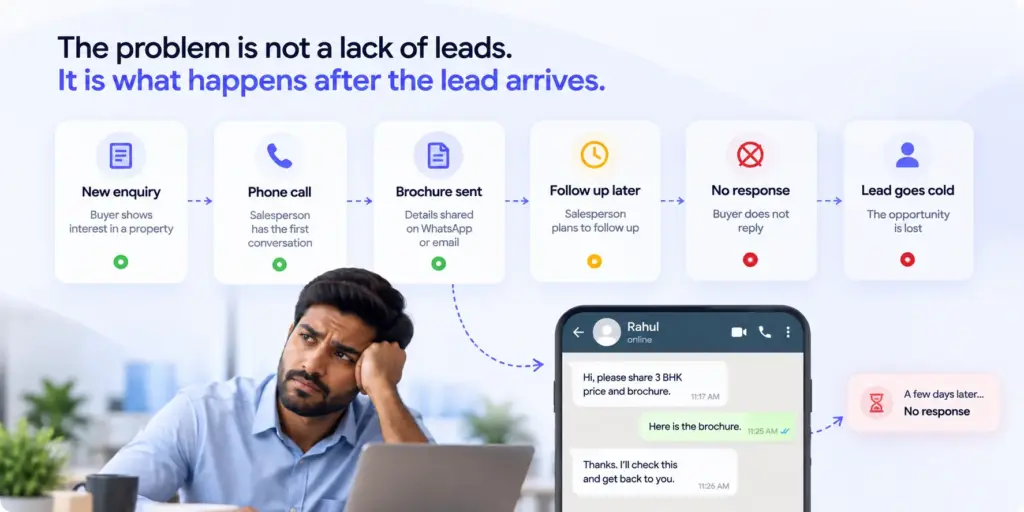
A property enquiry comes in at 11:17 AM.
The buyer is interested in a 3 BHK and wants the price and brochure. A salesperson calls, has a short conversation and sends the details on WhatsApp. The buyer says, “I’ll check this and get back to you.”
Then the day gets busy.
There are more leads to call, a site visit to manage, a customer asking for a cost sheet and another buyer negotiating a unit. The follow-up gets pushed to tomorrow.
Tomorrow becomes the next day.
A week later, the salesperson opens WhatsApp, sees hundreds of conversations and cannot immediately remember what happened with that buyer.
The lead is still there, but the opportunity has gone cold.
This is one of the most common problems in real estate sales. Companies invest heavily in generating enquiries, but the real challenge begins after the enquiry arrives.
The problem is not a lack of leads. It is what happens after the lead arrives.
Most real estate teams already know they need to follow up. The problem is that follow-up is often treated as an individual responsibility rather than a defined sales process.
A typical process looks like this:
New enquiry → phone call → brochure sent → follow up later → salesperson remembers → another call → no response → lead forgotten
There may be no clear rule for when the next contact should happen. The salesperson may not know what to discuss during the next call. The manager may have no easy way to identify leads that have not been contacted recently.
As lead volumes increase, this becomes harder to manage.
The first response is particularly important. Research published by Harvard Business Review found that most companies in its study did not respond quickly enough to online sales enquiries. The researchers found that companies responding within an hour were substantially more likely to qualify a lead than companies that waited longer. The research measured lead qualification, not completed sales, so it should not be interpreted as a guarantee that faster responses produce bookings. It does, however, show why response time matters at the beginning of a sales conversation.
For property buyers, the reason is easy to understand. A person enquiring about a home is rarely considering only one property. They may be speaking to several developers, checking property portals, talking to brokers and comparing prices at the same time.
If your team responds late, another salesperson may already be having the conversation.
But speed alone does not solve the problem.
The first response is only the beginning.
Why a single “follow up tomorrow” reminder is not enough
Imagine a salesperson receives a reminder:
Call Rahul tomorrow.
The reminder does not answer the questions that actually matter.
Why is Rahul interested? Which project did he enquire about? Which configuration does he want? Did he receive the brochure? Has he already visited the site? Which unit did he like? What was discussed during the previous call? What should the salesperson say next?
If the salesperson has to reconstruct the entire conversation before every follow-up, follow-up becomes another administrative task.
A better process keeps the context with the lead.
The salesperson should be able to see the enquiry source, project of interest, requirement, previous calls, WhatsApp conversations, site visits, follow-up history and next action without searching through several different tools.
This is the difference between maintaining a database of leads and actually managing leads.
The process should also change depending on where the buyer is in the sales journey.
A new enquiry needs a quick response and qualification. A buyer who has requested pricing needs relevant information. Someone who has scheduled a site visit needs confirmation and reminders. Someone who has already visited the property needs a conversation around objections, preferred units and pricing.
Sending the same “Any update, sir?” message at every stage is not a follow-up strategy.
A better real estate follow-up process
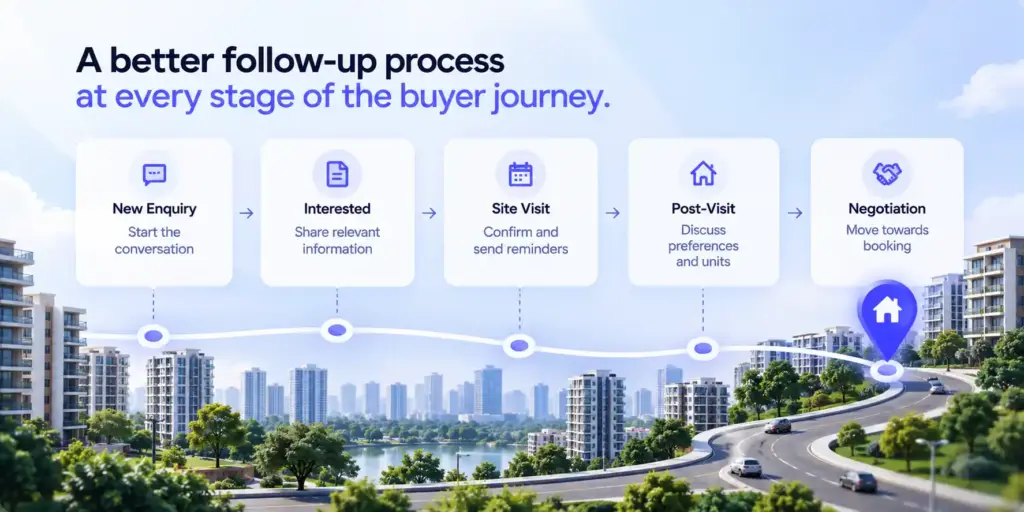
A useful follow-up system starts with the lead’s current situation.
When a new enquiry arrives, the first objective is to start a conversation. Instead of immediately sending a large brochure, the salesperson can confirm the requirement with a simple question:
“Are you mainly looking for a 2 BHK or 3 BHK?”
That gives the salesperson something to work with.
If the buyer does not answer the first call, the next interaction does not need to be another identical call. A short WhatsApp message can acknowledge the enquiry and ask when it would be convenient to speak.
If the buyer asks for pricing, the next follow-up should be about pricing.
If the buyer wants a site visit, the conversation should move toward fixing a date.
Once the site visit is scheduled, the process changes again. The buyer needs the location, time and confirmation. A reminder before the visit can reduce the chances of the appointment being forgotten.
After the site visit, the salesperson should not simply ask, “What did you think?”
The conversation can be more specific:
“You had mentioned that your budget was around ₹1.2 crore. Would you like me to show you the available units within that range?”
Now the salesperson is continuing the conversation rather than restarting it.
The principle is simple:
Every follow-up should have a reason.
That reason might be a question, an answer to something the buyer asked, a relevant unit, a site visit, a price update or the next step in the buying process.
WhatsApp makes the opportunity bigger, but also creates a management problem
For many Indian real estate teams, WhatsApp is already part of the sales process.
A lead may come from Facebook or Instagram, the salesperson calls, the brochure is sent on WhatsApp and the rest of the conversation happens there.
The problem begins when a sales team has hundreds or thousands of such conversations spread across individual phones.
Important information can remain inside personal WhatsApp conversations. Managers cannot easily see which leads are being followed up, which conversations have stopped and which prospects are close to booking.
This creates another risk: the lead starts belonging to the salesperson instead of the company.
A proper CRM brings the lead, communication history and sales process together.
Vastu CRM, for example, provides a Lead 360 view that brings calls, WhatsApp messages, emails, site visits, follow-ups and interested units together. It also supports WhatsApp Business API campaigns and automated follow-up sequences.
That means WhatsApp becomes part of the sales workflow instead of operating as a completely separate communication channel.
Automation should handle the predictable work
Automation is often misunderstood in real estate.
It does not mean sending the same promotional message to every lead.
Good automation handles the steps that should happen consistently but do not necessarily require a salesperson to perform them manually.
For example:
New lead → assign salesperson → initial response → follow-up → site visit → reminder → post-visit follow-up → nurture
If the buyer replies, books a visit or moves forward, the process can change.
This is where event-based automation becomes useful. Instead of asking salespeople to remember every follow-up, the system can trigger the appropriate action based on what happened to the lead.
Vastu CRM supports WhatsApp and email drip sequences that can be triggered by lead events and can stop when a lead replies or books. The current website also shows lead sources such as Facebook Lead Ads, 99acres, MagicBricks, Housing.com, website enquiries and phone calls flowing into a common pipeline.
The salesperson still owns the relationship.
Automation simply makes sure the process does not depend entirely on memory.
Managers need to see where leads are getting stuck
A sales manager looking at “500 leads this month” does not have enough information.
The useful questions are different:
- How many new leads have not been contacted?
- Which leads have overdue follow-ups?
- Which leads have not been contacted for several days?
- How many site visits were scheduled?
- How many actually happened?
- Which lead sources produce site visits?
- Which leads are sitting in the same stage for too long?
These questions help identify where the sales process is breaking.
Suppose a developer receives 500 enquiries but only 50 become site visits. The immediate problem may not be closing. It could be lead qualification or follow-up.
If 100 people visit the project but only five reach negotiation, the problem is somewhere else.
A pipeline makes these gaps visible.
Vastu CRM includes lead status tracking, follow-up scheduling, a Today view for salespeople, sales pipeline reporting and performance dashboards.
A simple system is often enough to start
A real estate sales team does not need a complicated process to improve follow-up.
A basic pipeline can have seven stages:
New → Contacted → Interested → Site Visit Scheduled → Site Visit Done → Negotiation → Booked/Lost
Each stage should have a clear next action.
For a new lead, the action is to make contact.
For an interested lead, it may be to share relevant property information or schedule a visit.
For a scheduled visit, it is confirmation and attendance.
After the visit, it is understanding objections and identifying the right unit.
During negotiation, it is moving toward a booking decision.
The exact stages can differ between a developer and a broker, but the principle remains the same: a lead should never sit in the pipeline without knowing what happens next.
This also makes reporting more useful. Instead of simply measuring how many leads were generated, a company can understand how those leads moved through the sales process.
The real value of a CRM is not storing phone numbers
A spreadsheet can store a name and phone number.
WhatsApp can store a conversation.
A portal can store an enquiry.
An email inbox can store a message.
But none of these, on its own, answers the most important question:
What should happen with this lead next?
A real estate CRM connects the different parts of the process:
Lead source → salesperson → conversation → requirement → property → site visit → follow-up → negotiation → booking
For developers, the process can continue into:
Booking → payment plan → demand → collection → post-sales → possession
That is why a CRM built around real estate can be more useful than a generic contact database.
The software should follow the way the business actually sells property.
A simple system is often enough to start
A real estate sales team does not need a complicated process to improve follow-up.
A basic pipeline can have seven stages:
New → Contacted → Interested → Site Visit Scheduled → Site Visit Done → Negotiation → Booked/Lost
Each stage should have a clear next action.
For a new lead, the action is to make contact.
For an interested lead, it may be to share relevant property information or schedule a visit.
For a scheduled visit, it is confirmation and attendance.
After the visit, it is understanding objections and identifying the right unit.
During negotiation, it is moving toward a booking decision.
The exact stages can differ between a developer and a broker, but the principle remains the same: a lead should never sit in the pipeline without knowing what happens next.
This also makes reporting more useful. Instead of simply measuring how many leads were generated, a company can understand how those leads moved through the sales process.
The real value of a CRM is not storing phone numbers
A spreadsheet can store a name and phone number.
WhatsApp can store a conversation.
A portal can store an enquiry.
An email inbox can store a message.
But none of these, on its own, answers the most important question:
What should happen with this lead next?
A real estate CRM connects the different parts of the process:
Lead source → salesperson → conversation → requirement → property → site visit → follow-up → negotiation → booking
For developers, the process can continue into:
Booking → payment plan → demand → collection → post-sales → possession
That is why a CRM built around real estate can be more useful than a generic contact database.
The software should follow the way the business actually sells property.
How Vastu CRM fits into the process
Vastu CRM is designed around the sales workflow used by builders, developers, brokers and channel partners. Its builder workflow covers lead management, follow-ups, inventory, cost sheets, bookings and collections, while the broker workflow covers listings, builder relationships and deals.
For the specific problem of leads going cold, the relevant pieces are lead routing, Lead 360, follow-up scheduling, the Today view, WhatsApp and email automation, and reporting.
The goal is not to make salespeople send more messages.
It is to make sure that genuine opportunities do not disappear simply because someone forgot what needed to happen next.
The question real estate companies should ask
The important question is not:
“How many leads did we generate this month?”
It is:
“What happened to every lead after it arrived?”
Can you see who contacted the buyer?
Can you see what they were interested in?
Can you see whether they visited the property?
Can you see when the next follow-up is due?
Can you identify leads that have gone silent?
Can you see which opportunities are close to booking?
If not, generating more leads may simply put more prospects into the same broken process.
Real estate sales will always depend on people and relationships. A CRM does not replace that relationship.
It gives the salesperson the context to have a better conversation and gives the manager the visibility to understand where opportunities are being lost.
The objective is not to chase every buyer every day. It is to make sure that every genuine opportunity has a clear next step.